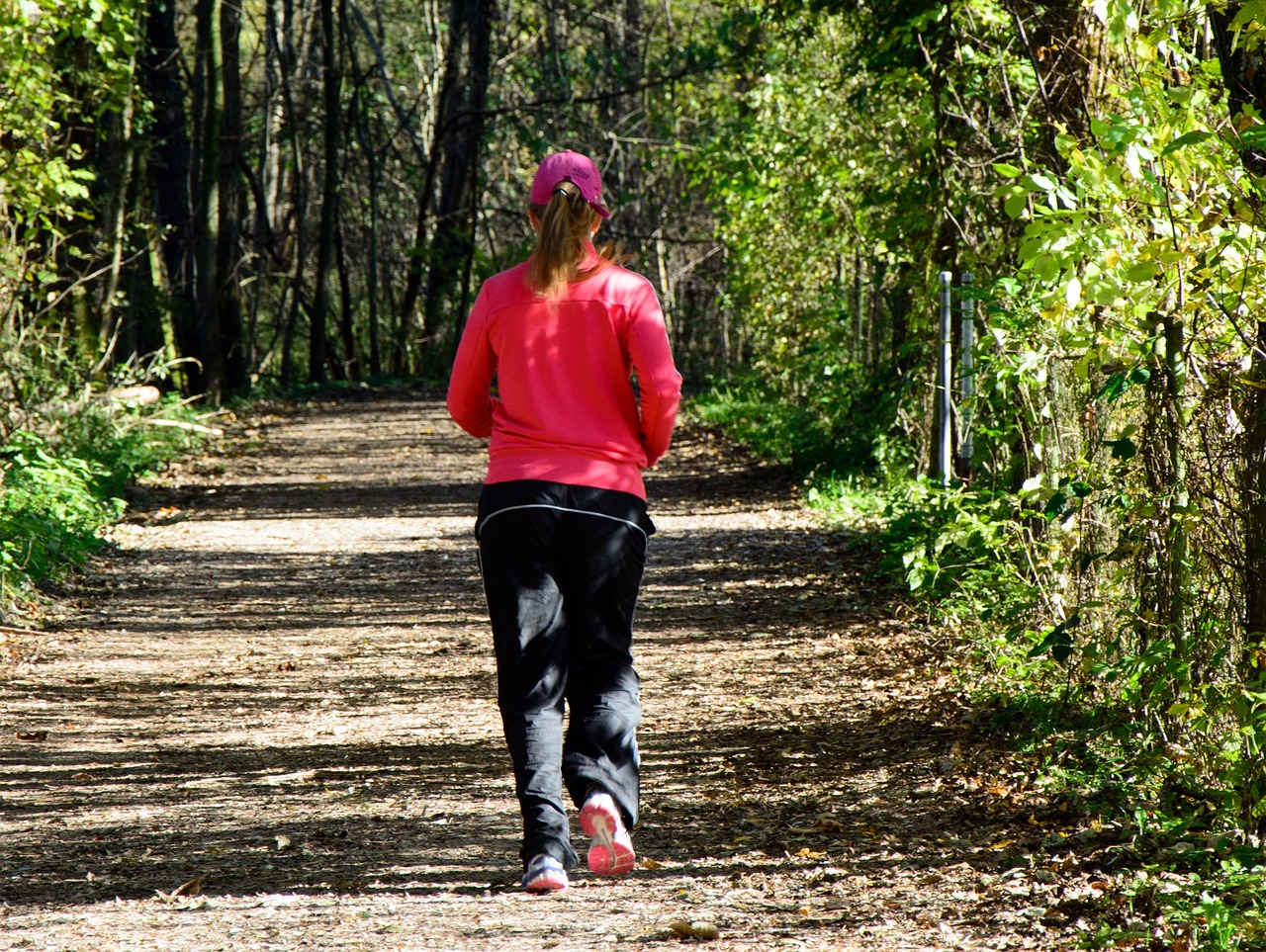
If your dog is missing take advantage of those who travel the area frequently. Talk to your mail carrier, garbage truck driver, school bus drivers, joggers, hikers, dog walkers and those who frequent the dog park. Ask them to keep an eye out and hand them your lost dog’s flyer. You can make smaller flyers that come 4 to a sheet to save printing costs. An extra set of eyes could make all the difference and may help bring your dog home sooner!
To create your free flyer and social media links to help you generate sightings of your missing dog please file a report with our partner, Pet FBI at www.petfbi.org. One of our volunteers will post your dog’s listing to our highly popular Facebook page, Lost Dogs of Wisconsin.
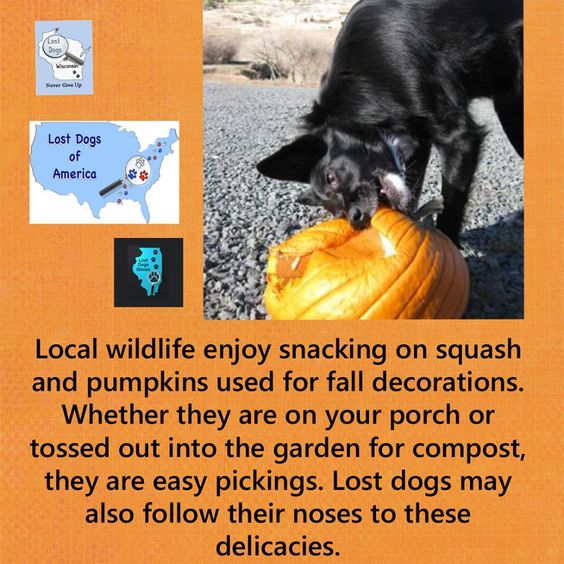
Leftover pumpkins in fields and yards make an easy meal for a hungry lost dog. Check for dog tracks and other signs that your lost dog may be munching on pumpkins or squash! Distribute flyers in the area and ask people to check their trail cameras.
We just wanted to take a quick moment to remind you of the importance of changing your voicemail and answering machine messages if your dog goes missing. We know this is something that a lot of dog owners overlook, but it’s really important to let people know that your dog is missing so that they can help you find them.
Because most people cannot always answer their phone, it is important for you to realize that your recorded greeting is what will make a first impression on someone who is trying to share information about your lost pet when you are not available to take a call. If your message does not indicate that your dog is lost and you are trying to recover your pet, but are simply unable to answer the phone at that exact moment, the caller may decide you don’t really want your dog back. Or the person may think you don’t deserve to get your dog back since you didn’t have a moment to pick up the phone.
Right or wrong, people can be justifiably or unduly judgmental. So it’s vital that your message communicate that your dog is currently missing, you are eager to have your pet returned to you because you love and care for him or her, and that you will respond to any caller who leaves a message for you as quickly as possible.
Here’s a few tips for writing a good voicemail message when your dog is missing:
Be clear and concise. State that your dog is missing and give a brief description of them.
Include your contact information. Let people know how they can reach you if they have any information about your dog.
Be positive and hopeful. Thank people for their help and let them know that you’re grateful for any information they can provide.
“Wait! Please don’t hang up! I have a lost dog. If you are calling because you think you saw my dog, please leave a message. I’ll return your call as soon as I possibly can. Thank you for your help!”
Look at it this way. If one of your family members was missing, any caller could be trying to contact you to share information necessary for your loved one to make it back home. And since many of us view our pets as children, the circumstances are very similar, meaning every caller could provide information that helps you get your dog back.
It is important that you change your voicemail and answering machine greetings to messages that will encourage, not dissuade people to leave messages for you. Simply changing your messages can be the difference between someone choosing to leave a helpful message for you or not. It could mean the difference between your dog being returned to you or not.
To create your free flyer and social media links to help you generate sightings of your missing dog please file a report with our partner, Pet FBI at www.petfbi.org. One of our volunteers will post your dog’s listing to our page.
We often hear “I know my dog was stolen because he never left the yard before.” We have learned just because they haven’t before doesn’t mean they won’t.
Theories and assumptions can lead you to concentrate in only one direction. Keep an open mind and cover all of your bases.
Getting the word out, especially flyers and intersection signs, are two of the most important things you can do. Remember, although it is a great tool not everyone is on social media.
You can also visit our website lostdogsofwisconsin.org for more great ideas to help get your dog home.
Using large signs is one of the most effective things you can do to get your lost dog back home. Signs alert passing motorists who may see your dog and then instantly have the phone number to call.
Here is an article from our website to help guide you through the process of making and positioning signs for best results: Creating and Placing Effective Signs
The following write up is from a volunteer who helped with catching Mama safely:
A kind man saw one of the Lost Dog Signs while driving to work. On his way to work he spotted a black lab in the middle of CTY K in Star Lake. (Approx. 11 miles from where Mama escaped) The dog came right to him but would not get in his truck. The dog trotted off to a nearby house. He called the number on the sign he saw. He was positive it was her, right down to the blue collar.
After getting permission from the homeowner of the house of which the dog was seen going towards, the search began. But it didn’t take long as the dog came right up to us. It was indeed Mama! With a lead on her, she went to where her baby was. Both Mama (now Nya) and the puppy (Baby Nya) were taken to the Vet to be checked over. The puppy is in good health and Mama is doing well. The vet said the puppy is only a few days old. There was an extensive search for any other puppies but none were found. * Initially, Mama was brought in for a full check up and the Vet said it was unclear if her puppies would make it. She was in poor health and had an inadequate diet. She is heartworm positive, Lyme positive and anaplasmosis positive. She also had two pellets in her from a pellet gun and one other low caliber bullet in her. It’s believed that the other puppies were either still born, or simply just not strong enough to survive. Thank you to everyone who helped by sharing her flyer and offering help in other ways.”
When your pet goes missing you want to be sure that you use every available tool at your disposal to help you. Thankfully, technology has made some great leaps and bounds in recent years and today we want to tell you about three different search features you’ll want to use.
24 Pet Connect (formerly Pet Harbor) is a shelter software system used by many of the large animal control facilites in North America. You can search the listings manually for your lost pet but better yet, you can register to receive emails every time a possible match for your pet is entered into the system. You can filter these results by distance, animal type, breed, gender, age, size and color.
Adopt a Pet, an online adoption tool used by shelters, has a similar feature. Enter the description details about your missing pet and you will be sent an email notification when there is a possible match to your criteria. Adjust the distance filter in case your missing pet ends up in a shelter or rescue far away from home. Remember pets can travel or be transported a long distance and you wouldn’t want to miss a possible match.
Petfinder, another online adoption tool utilized by shelters, doesn’t currently have an email alert system but you can save your search, bookmark the page and then set yourself a reminder to check frequently to see if there is a possible match to your pet.
Make sure if you set up these email alert systems that you add them to your “approved senders” list so that they don’t get caught in your email’s spam filter.
Of course, computer-made matches shouldn’t substitute for calling and visiting the shelters in person, but they can be a very useful tool, especially to scan shelters far away or for searches which go on for months or years.
When your dog goes missing your telephone is vital to their recovery. When you make a lost dog report enter your phone number correctly. Take a minute and review it. If entered incorrectly changing it takes up valuable time and you may lose shares on Facebook pages.
Make sure your voicemail box is not full. If someone is trying to reach you and cannot leave a message they may not make the effort to try again.
Remember that there are people that may try and scam you. If they ask for a verification code ignore or delete the message.
If your pet is missing hopefully your phone will be ringing soon with good news!
When we talk to owners of missing dogs we often hear “I have looked EVERYPLACE”. It may seem like it, but the truth is no you haven’t.
Dogs, big and small, can go into survival mode and run from people including their owners. They can hide in the most unlikely spots. Dogs have been located in storm drains, under porches, window wells, between hay bales, attics, the roof of the house and even in the folds of a couch (yes, a very small dog.)
“Well, my dog would bark.” You may think so but a dog in survival mode acts much different than a dog would normally.
While it is not feasible to look EVERYPLACE the bottom line is don’t just give up because you haven’t found them yet. Start close to home and expand outward. Look in buildings that the doors are closed as they may have followed someone in and they didn’t notice. Look for clues such as pawprints. Your dog may be right under your nose!
Buttons, reunited after 14 days! She was hiding in a storm drain.
The mission of Lost Dogs of Wisconsin is simple. To try and help reunite lost and found dogs. We couldn’t do it without the help and support of our fans. Your tips,sightings and watchful eyes have reunited countless dogs. We and the owners thank you for this.
Please be mindful and positive in your comments however. In most cases, the circumstances are unknown and being judgemental is not going to bring the dog home. Negative comments may be deleted and that also takes up valuable time for our volunteers monitoring comments.
Let’s make 2022 a record year for reuniteds. We can do it. Never give up!
(as told by Gina from Chasing Daylight Animal Shelter in Tomah, Wisconsin)
Lynn is a story of survival….She was out on her own for 59 days….She was a dog lost off of transport from Waco, Texas who arrived in Tomah, Wisconsin in October. She bolted from her crate on the day of transport on October 12th on Curry Street in Tomah. This is about three miles southeast of where she finally settled. The rescue group had an initial search party but didn’t have any sightings until we received one on October 31st.
Dogs can survive if not pushed, chased or forced to leave their “safe zone”. The eyes and reporting of Jessica, Bill and Lynn Rose made the difference in her recovery.
The efforts of Beth S, Pamela C, and Susan C were incredible. She was microchipped from the receiving rescue and they graciously turned her over to us. I am so grateful. When you spend 41 days trying to gain the trust of a dog on the run you become very attached. Dogs will often stay near where they were lost, they will stay if not pushed and have a food source. Patience is the key. She survived her cornfield being harvested, deer gun season, and Thanksgiving holiday travel.
In an effort to help other owners learn about lost dog behavior I would like to share a timeline of our involvement:
1. Contacted on October 31st about a brown and black dog that runs between Walmart and their farm by Jessica D. I went out that day and searched the area with no sighting. Went out several times over the next two weeks without seeing the dog.
2. Contacted on November 12th with a sighting of the same dog by Bill, he adopted Sasha, from CDAS. “I was leaving Walmart at 2110 and had just made the curve leading into traffic when a dog raced across the road from east to west. It went about 50 feet into the grass and sat down looking back to where it came from”. “It looked like maybe 35-40 pounds black & brown mutt”. “Straight across from the strip mall between Maurice’s and the traffic light”.
3. Contacted by Lynn at CDAS on November 24th at 0200, when I was there late at night checking on Idaho. She had left a voicemail about a stray dog running across Walmart parking lot consistently each night when she is doing a drop load there as a semi driver. The dog reportedly eats near the dumpster behind US Cellular.
4. Contacted Amber D at MCAS to let her know I was actively trying to live trap a dog that has been running at large for some time. November 24th.
5. Live trap set out at the US Cellular dump. The dog would eat the goods near the trap but not enter..November 24th
6. November 27th Meg Scott saw the dog run across highway 21 near the substation and Linda Johnson’s property. Live trap set up there too. The first night all food was eaten near the trap.
7. Thursday December 2nd, I went and walked the area near the cell tower. I also walked the land behind Johnson’s to Hampton etc….within the hour Beth sees the dog where I had walked….Live trap from Linda J’s moved to cell tower site. Family that rents the farmland agrees to let us set up trap. Pam & Eve contacted about the dog and I asked for help!
8. Friday, December 3rd Beth & I both observe the dog at the cell tower site.
9. Saturday, December 4th The beginning of the Missy Trap set up with Pam, Susan, Beth and me. Two back panels, two side panels on each side. Old pet porter in place. Confirmed sightings! 1850, 1900,
10. Sunday, December 5th Large old pet porter removed, new one placed. Bowl moved to back of Missy Trap. Confirmed sightings! 0248, 1300. 2211, 2253
11. Confirmed Sightings December 6th: 0350, 1239, 1436, 2200 for extended time. Brutal cold with Wind Chills
12. December 7th: Confirmed sightings at 0830 soon after Beth fed! Additional panels place. Hot broasted chicken left ~1100. Sightings: 1130 ½ hour after adding panels! 2100, 0100
13. Wednesday December 8th: 0819, 0900, Added several additional panels @ 1045. Watching in a field and we observed her coming back to the site as we were leaving. One hour later seen in Walmart parking lot and pursued to field…Additional equipment all placed….Finished around 1700. Trap armed until 1900…no sightings….Back at 0200
14. Thursday, December 9th: Lynn did not eat the food overnight at the back of trap….day of rest and no changes…..1005, 1500, 1530, 1600, 1630 near trap but will not enter! 2030 enters the trap! Spent about 6 minutes in the trap. Entered the trap during the night.
15. Friday, December 10th: Entered the trap 0700 looking for food…. Beth fed around 0800 and trap was armed…… 1000 successful trapping of Lynn and transport to CDAS. It took over an hour to gain her trust and get her crated. She tried to bolt!!! Lynn secure at CD
It was truly a group effort of the sightings by Jessica, Bill and Lynn. Then the help of Beth, Pam and Susan. The Missy Trap was the key to her rescue and God watching over her each day.






 Lost Dogs of Wisconsin